

A few years ago, a former student came up to me with a question that sounded simple, but clued me into a deeper problem. He said, “Hey, I’ve been reading the book of Mark like you told me to… but now what? I don’t really know what to do after that.”
He wasn’t lazy. He was trying, but like so many students today, he didn’t have a framework for how to read the Bible - no direction or understanding of what he was even looking for. That moment stuck with me because it reminded me: opening their Bibles is not the same as reading it well. So how do we help them read the Bible for themselves?

1. Don’t Just Assign Reading, Teach Them How to Read
Most students today have access to more Bible content than any generation in history. They have devotionals, podcasts, verse-of-the-day notifications, and more Bible apps than they can count. But often the approach is haphazard, rather than intentional. If we want students to love God’s Word, we can’t just tell them what to read - we have to show them how to read.
In ministry, I’ve found that starting with curiosity is key. Instead of giving a “read this and report back” type of challenge, I try to model what it looks like to slow down and ask good questions. When we open Scripture together, I’ll say things like, “I wonder why Jesus said that?” or “What does that reveal about who God is?”
That kind of curiosity helps students see that the Bible isn’t a textbook - it’s a conversation with the living God. One of the biggest mistakes we make as youth pastors is assuming our students know how to engage with the Bible. Many of them don’t. We can change that by training them to ask three simple questions every time they read:
What’s it say?
What’s it mean?
What do I do with it?
(This is observation, interpretation, and application in everyday language). Those questions give structure without overcomplicating things - and they teach students to interact directly with God’s Word.
2. Help Them See Jesus, Not Just Themselves
A lot of devotional materials for students - even well-intentioned ones - tend to focus on self-improvement: how to handle stress, navigate relationships, or make wise choices. Those are good and necessary topics, but if that’s all we give them, we subtly teach them to read the Bible like a mirror instead of a window. The goal isn’t for students to find themselves in every story; it’s for them to see Jesus.
In Luke 24, Jesus says Moses, the Prophets, and the Psalms point to Him. When students see that Scripture is primarily about what God has done in Christ, duty turns into delight. And that’s what helps them read the Bible for themselves - and love the One they see.
3. Use Devotionals Intentionally
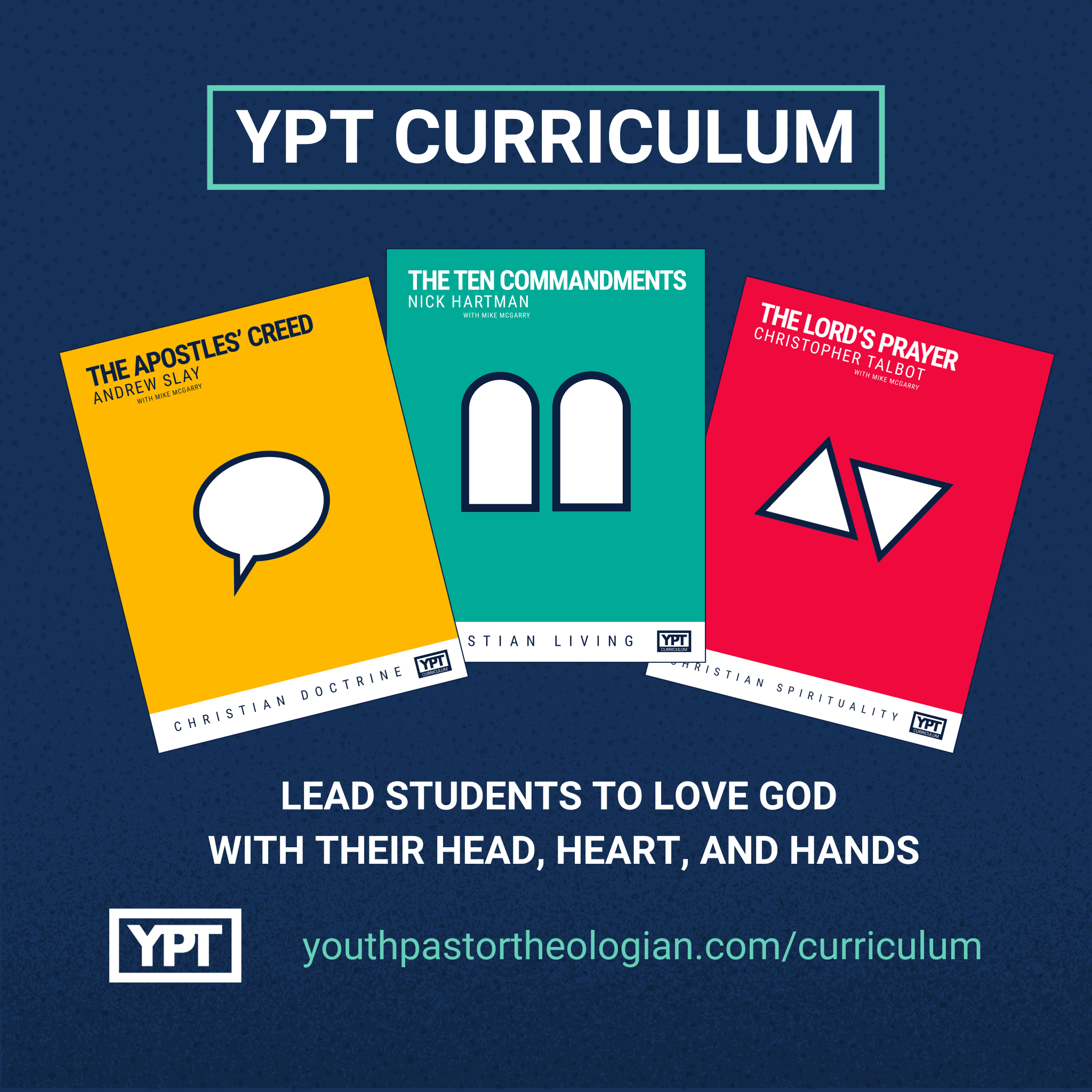
The YPT Curriculum is built around three historic branches of discipleship: Christian Doctrine, Christian Spirituality, and Christian Living.
The "Core Curriculum" is now available: Apostles Creed, Lord's Prayer, Ten Commandments.
One of the questions I heard most in student ministry was, “do you have any devotional recommendations?” Frankly, I didn’t. I always wanted God’s Word to be what they read, but many students don’t know where to begin – and since their teen years can help to lay a foundation for their lifelong habits, finding helpful resources is important. The problem I found with devotionals for students was many were either too far beyond their season of life, or too far beneath them. Devotionals, podcasts, and Bible app plans can be incredibly helpful tools - if we use them wisely. They should function like training wheels on a bike: they can help students learn balance, but the goal is for them to eventually ride on their own. The danger is when devotionals replace the Bible instead of reinforcing it. I’ve seen students read a short paragraph from a devotional, close it, and feel like they’ve “spent time with God.” The words may be good, but they’re not the Word.
That tension is why I started writing resources that push students back into Scripture. With Him: A 90-Day Devotional for Students aims to walk with them passage by passage, helping them meet Jesus in the text - rather than just reading my thoughts about it. Ultimately, if a devotional or reading plan doesn’t help students see Jesus more clearly, then it’s missing the point.
A good devotional will always drive readers back to Scripture. It will stir hunger for more of God’s Word, and will refuse to try to satisfy it apart from the Bible. So, when youth pastors recommend devotionals or Bible app plans, we should evaluate them with a simple test:
Does it put Scripture front and center?
Does it prompt reflection on God’s Word more than the author’s words?
Does it lead the reader to Jesus?
If it does, then use it joyfully. But always remind students that devotionals are a bridge, not a destination.
4. Model a Slow, Steady Faithfulness
Students today are used to instant results - instant downloads, instant answers, instant gratification. Bible reading doesn’t work that way. Perhaps you’ve heard the helpful illustration that it’s more like a savings account than an ATM. You don’t always feel the impact immediately, but over time, truth accumulates.
That’s why our modeling matters so much. When students see us consistently meeting with God, even through the mundane, they learn that the Bible is more than a source of inspiration; it’s the source of life. You don’t have to be flashy - just keep opening the Bible with them, helping them to see new beauty in it. Keep pointing them to Jesus. Keep reminding them that every page is another opportunity to know Him.
5. Give Them a Path Forward
Back to that student who read the book of Mark. After we talked, I realized I had handed him a starting point but not a path. He didn’t need more motivation; he needed direction. So, we sat down and made a plan. That conversation became the seed of With Him—because so many students are willing and eager; they just need the dots connected. I wanted other students - and the leaders who shepherd them - to have a roadmap that would help them take those next steps. If we can help students connect the dots, we’ll give them something far better than short-term excitement: a lifelong habit of meeting with God.
Youth pastors, our job isn’t to make the Bible easier. It’s to show students that learning to study it well is worth it. It has the power to enlighten them, to convict them, and to shape them to look like Christ. Our hope is that once students learn to hear God speak through His Word, they’ll never be satisfied with anything less. So keep pointing them back to the Word of God, which is living and active - and when students begin to experience that, everything changes.